

In general, your credit card rewards are worth 1 cent per point when redeemed for travel or cash-back. That makes the mental math incredibly simple: 10,000 points are worth roughly $100, 50,000 points are worth about $500, and so on.
But transferring those points to eligible partner programs is where things get exciting — and that’s the foundation of what we focus on at Upgraded Points. The playback goes like this: Earn the right rewards currencies, find award availability for the trip you want, and then transfer points to airline or hotel loyalty partners to secure those bookings.
With this strategy, we’re no strangers to seeing double, triple, or even far more than that standard 1-cent-per-point value.
Not only is there a right way to redeem your points, but there’s also a right time to transfer them. Here’s why I often wait until the first of the month before moving any points to airline or hotel partners.
What Are Credit Card Transfer Partners?
Each credit card rewards program comes with its own lineup of transfer partners. While many overlap, some programs offer unique airline and hotel partners, which is why we always stress the importance of diversifying your rewards strategy. This simply expands your options across multiple ecosystems.
Before you transfer your points, confirm that award availability exists for your desired dates and number of passengers. In 99% of cases, transfers are permanent, meaning you typically aren’t able to reverse the transaction or move your points back once it’s complete.

While we’d love for every transfer partner to offer a simple 1:1 transfer ratio, that’s not always the case. In fact, Chase Ultimate Rewards is currently the only major transferable points program that maintains a 1:1 transfer ratio across all its partners.
In some scenarios, transfers actually have a reduced value, with 1 credit card point converting to between 0.5 and 0.8 points in the partner loyalty program.
That said, there are also situations where transfers get you more bang for your buck. For example, American Express Membership Rewards points transfer to Hilton Honors at a 1:2 ratio, meaning every 1 Membership Rewards point becomes 2 Hilton Honors points.
How Frequent Are Transfer Bonuses?
Although these transfer ratios are well defined within each rewards program, issuers may run limited-time promotions that let you get even more value from your points. These are known as transfer bonuses, which offer around 10% to 40% more points or miles when you transfer to a specific airline or hotel partner.
These promotions usually last a few weeks, though some issuers offer transfer bonuses far more frequently than others. American Express Membership Rewards and Chase Ultimate Rewards regularly feature well over a dozen transfer bonuses each year, so it’s common to see at least 1 active promotion every month.
Bilt Rewards takes a unique approach with its monthly Rent Day promotions, which launch on the first day of each month and often include transfer bonuses of up to 100% with a featured partner. While these offers can be significantly more lucrative than traditional transfer bonuses, they’re also much more restrictive, as the elevated rates are typically available for that single day.
On the other hand, programs like Citi ThankYou Rewards and Capital One miles tend to be much less frequent, often offering only a handful of transfer bonuses annually. We’ve yet to see anything from Wells Fargo Rewards since the program launched transfer partners in April 2024.
Not Every Transfer Partner Gets a Bonus
To add another layer of complexity, transfer bonuses are generally reserved for certain partners, and here’s why.
Arguably, the most valuable transfer partner in the Bilt Rewards ecosystem is Alaska Airlines Atmos Rewards, and because of that value, Bilt has never offered a transfer bonus to the program. Similarly, Chase has never provided a transfer bonus to World of Hyatt beyond its standard 1:1 transfer ratio, likely because the program already offers strong redemption value on its own.
That’s where transfer bonuses become slightly more predictable. Here are some of the partners we’ve seen within the past year or so:
- Chase: Air Canada Aeroplan; British Airways, Iberia, and Aer Lingus Avios; Air France-KLM Flying Blue; Southwest Rapid Rewards; Marriott Bonvoy; Wyndham Rewards; and Virgin Atlantic Flying Club
- American Express: British Airways Executive Club, Air France-KLM Flying Blue, JetBlue TrueBlue, Hilton Honors, Marriott Bonvoy, Singapore Airlines KrisFlyer, and Virgin Atlantic Flying Club
- Capital One: Air France-KLM Flying Blue, Avianca LifeMiles, British Airways Executive Club, Emirates Skywards, Japan Airlines Mileage Bank, Qantas Frequent Flyer, Preferred Hotels, and Virgin Red
- Citi: Air France-KLM Flying Blue, Avianca LifeMiles, Qantas Frequent Flyer, Leading Hotels of the World, and Virgin Atlantic Flying Club
So why wait until the first of the month to transfer points? According to MaxMilesPoints, a credit card points and travel expert, more than half of all transfer bonus promotions launch at the beginning of a new month. He publishes a transfer bonus predictor tool that captures historical and incoming data on these promotions.
We’ve noticed the same trend in our own coverage of new transfer bonuses. Many promotions appear in members’ accounts right as the calendar flips over, which means that even if there isn’t a compelling transfer bonus available today, waiting until the first of the month could open the door to a better opportunity.
Transfer Bonus Partners I Watch Most Closely
Not all transfer bonuses are home runs. Some partners simply provide far more value than others.
Personally, I overlook most hotel transfer promotions, except those from American Express Membership Rewards to Hilton Honors. Those transfer bonuses can be especially compelling, since they boost an already generous 1:2 transfer ratio even higher.
The transfer bonuses I pay the closest attention to are tied to airline loyalty programs. In particular, I watch out for promotions with Air Canada Aeroplan, Air France-KLM Flying Blue, and Virgin Atlantic Flying Club.
Here are just a few examples of incredible flight redemptions I’ve booked for even fewer points thanks to transfer bonuses.
1. United Polaris Seats to Italy for 59,000 Points
Air Canada Aeroplan is one of the best loyalty programs for booking business class flights on Star Alliance airlines. The program often provides better award availability for multiple passengers than it does for a single premium cabin seat.
One year, instead of staying home for Thanksgiving, I used points to treat my family to 4 United Polaris business class tickets from Washington, D.C. (IAD), to Rome (FCO).
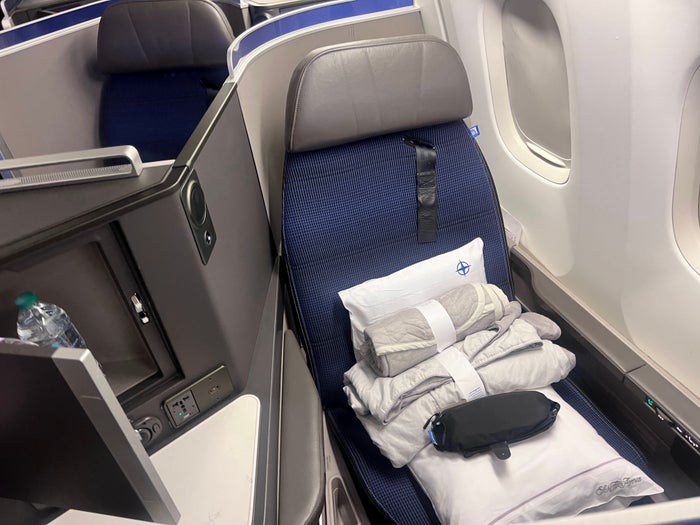
A 20% transfer bonus from Chase to Aeroplan lined up perfectly with our travels: Rather than 70,000 points and $100 in taxes and fees per ticket, I used just 59,000 points per person, earned from my Chase Sapphire Preferred® Card.
The trip started off strong with access to the excellent United Polaris Lounge at Dulles, where we relaxed and enjoyed a full meal before boarding. Then, after sleeping through most of the 8-hour overnight flight in lie-flat seats, we landed in Italy with virtually no jet lag and were ready to start sightseeing.
2. Domestic Delta Flights for 12,000 Points
I fly Delta more than any other domestic airline, but most people in the points and miles world know that SkyMiles redemptions can often be lackluster.
Thanks to Delta’s dynamic award pricing, redemption rates have steadily climbed over the years. It’s not uncommon to see Main Cabin flights from my home in Salt Lake City (SLC) to visit family in Raleigh-Durham (RDU), North Carolina, priced at more than 40,000 SkyMiles one-way, which, frankly, isn’t a great value.
My workaround? Booking the exact same Delta-operated nonstop flight through Delta’s partner program, Air France-KLM Flying Blue, for a fraction of the cost. Flying Blue is one of the programs most frequently included in transfer bonus promotions across the major transferable currencies, and the bonus is often around 20%.

Since those promotions pop up a few times each year, I’m more than happy to wait until the first of the month to transfer points, knowing I’ll likely use them to book flights either for myself or for my mom to visit me in the future.
That strategy has paid off tremendously. Flying Blue often prices this exact same route at just 14,000 miles plus around $15 in taxes and fees, assuming saver-level award availability exists. That’s because Flying Blue generally prices many partner awards based more on distance and fixed award logic rather than Delta’s unpredictable dynamic pricing model.
I usually take advantage of the Amex to Flying Blue transfer bonuses, with points earned from my Platinum Card® from American Express and my American Express® Gold Card.
As such, I only end up paying 12,000 points per ticket — and for a Main Cabin seat, not basic economy. (Plus, having Delta elite status means I’m eligible for upgrades to first class.)
Hot Tip: Apply and find out if you’re eligible for a welcome bonus offer of as high as 175,000 points with the Amex Platinum. Welcome offers may vary, and you may not be eligible for an offer.
3. ANA Business Class to Tokyo for 43,000 Points
This may have been one of the best points redemptions I’ve ever booked.
I took advantage of a 40% transfer bonus from Chase Ultimate Rewards to Virgin Atlantic Flying Club. By transferring 43,000 Chase points, I received around 60,000 Flying Club points — just enough to book an ANA business class flight from New York (JFK) to Tokyo (NRT).

Because I searched for award availability a whole year in advance, I locked in the 14-hour flight for just 43,000 Chase points plus roughly $400 in taxes and fees.
When you break it down, I essentially spent about 3,000 points per hour to fly comfortably across the Pacific, sleep in a lie-flat seat, enjoy incredible Japanese meals and ramen on board, and start my Asia trip on an amazing note.
Final Thoughts
Scoring the best award deals is all about combining multiple factors together. While there’s definitely some luck involved, timing is one area you can actually control by strategically waiting to see whether a favorable transfer bonus returns.
When that timing works in your favor, you’re effectively spending fewer transferable points for the exact same flight. That makes an already great redemption even more valuable.