
Key Takeaways
- Chase Pay Yourself Back® allows cardholders to redeem points for statement credits on select categories, offering up to 1.5 cents per point for Chase Sapphire Reserve® cardholders.
- The program offers flexibility, as points can be redeemed for everyday expenses rather than just travel bookings.
- For frequent travelers, transferring points to airline partners may still provide higher redemption value, but Pay Yourself Back is an excellent option for those looking for immediate savings.
After COVID-19 began impacting the global travel industry, banks and credit card issuers started offering ways to keep their travel-focused credit cards relevant.
American Express worked to boost the value proposition of its cards by offering new statement credits. And Chase came out with its own set of benefits — one being particularly interesting. Known as Pay Yourself Back, this feature is designed to increase the flexibility of your points by allowing them to be used to offset expenses.
In this guide, we’ll dissect the program and examine the pros and cons of using your rewards in this way. We’ll compare this benefit to those offered by Chase’s competitors and determine whether it’s worth taking advantage of.
What Is Chase Pay Yourself Back?
Chase’s Pay Yourself Back feature provides a way to use your Ultimate Rewards points to pay for existing purchases in select categories, effectively behaving as a statement credit to save on purchases. This is in addition to the many other fabulous ways to redeem Ultimate Rewards points for travel.
What Can I Use Pay Yourself Back For?
The rate you can redeem your points at through Pay Yourself Back varies depending on which card you hold. Let’s look at the rates and eligible categories for the cards that offer the Pay Yourself Back feature.
|
Chase Card |
Category |
Redemption Value |
|
Chase Sapphire Reserve® |
Eligible charities through December 31, 2026 |
1.5 cents per point |
|
$795 annual fee through December 31, 2026 |
1.25 cents per point |
|
|
Department store purchases through December 31, 2026 |
1.20 cents per point |
|
|
Wholesale clubs and groceries (excluding Target and Walmart) through December 31, 2026 |
1.15 cents per point |
|
|
Eligible charities through December 31, 2026 |
1.25 cents per point |
|
Cardholder annual fee through December 31, 2026 |
1.1 cents per point |
|
|
Sapphire Reserve for Business℠ |
Eligible charities through December 31, 2026 |
1.25 cents per point |
|
Eligible charities through December 31, 2026 |
1.25 cents per point |
|
|
1.25 cents per point |
|
Chase Air Canada Aeroplan® Credit Card |
Annual fee (within 90 days of billing) for a limited time |
2 cents per point |
|
Travel purchases |
1.25 cents per point for annual fee and travel (maximum of 200,000 points or $2,500 in value per year) |
|
|
Marriott Bonvoy Bold® Credit Card |
Marriott hotel or direct airline purchases (for up to $750) |
0.8 cents per point |
|
Southwest credit cards |
Annual fee (within 90 days of billing) |
1 cent per point |
|
United credit cards (those with an annual fee) |
Annual fee posted within the previous 90 days (no deadline yet; only on cards with an annual fee), and eligible United airfare transactions of $50 or more made within the last 90 days (all United credit cards are eligible) |
1.35 to 1.50 cents per mile on annual fee; 1 cent per mile for United airfare |
|
J.P. Morgan Reserve Card |
Eligible charities through December 31, 2026 |
1.5 cents per point |
|
Annual fee of $550 through December 31, 2026 |
1.25 cents per point |
|
|
Department stores through December 31, 2026 |
1.2 cents per point |
|
|
Wholesale clubs and groceries (excluding Target and Walmart) through December 31, 2026 |
1.15 cents per point |
|
|
Disney credit cards |
Redeem Rewards Dollars for a statement credit toward purchases made at most Disney locations in the U.S. and online at Disney sites including DisneyStore.com, DisneyPlus.com, Hulu.com, and Plus.ESPN.com. Must redeem through Chase Pay Yourself back within 90 days of purchase. |
1 cent per point |
|
Disney® Premier Visa® Card and Disney® Inspire Visa® Card |
edeem Rewards Dollars toward airline purchases including tickets on any airline to any destination with no block-out dates. |
1 cent per point |
Donations to the following charities qualify for Chase Pay Yourself Back:
- Alzheimer’s Association
- American Heart Association
- American Red Cross
- Equal Justice Initiative
- Feeding America
- GLSEN
- Habitat for Humanity
- International Medical Corps
- International Rescue Committee
- Leadership Conference Education Fund
- Make-A-Wish America
- NAACP Legal Defense and Education Fund
- National Urban League
- Out and Equal Workplace Advocates
- SAGE
- Thurgood Marshall College Fund
- United Negro College Fund
- UNICEF USA
- United Way
- World Central Kitchen
How Do I Use Pay Yourself Back?
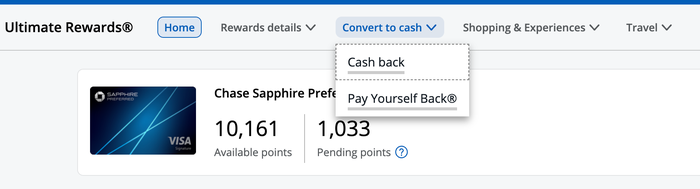
The easiest way to use Pay Yourself Back is by logging in to your Chase Online account using your username and password. Once logged in, click the Rewards button to be taken to the Ultimate Rewards portal.
Next, you may need to choose the card you’d like to redeem Ultimate Rewards points from. In this example, there’s only 1 card in the account. So, you can simply click the Convert to Cash dropdown to Pay Yourself Back.
On the Pay Yourself Back landing page, your eligible transactions will be displayed in a list. The list will show how many days you have to redeem your Ultimate Rewards points for each eligible purchase. Select the transactions you’d like to use Pay Yourself Back on by checking the box. Then click the Continue button.
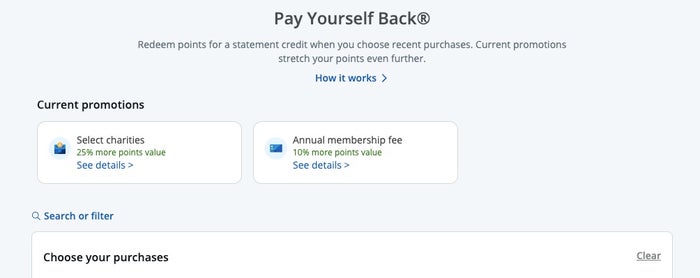
Apply the cash value you’d like to use points for. If you want to use the maximum number of points possible, check off the box that says Apply Full Amount. Then click Redeem to use your points.
You also can perform this same process through the Chase Mobile app.
Best Ways To Earn Chase Ultimate Rewards Points
One of the best aspects of Chase Ultimate Rewards is that the points are so valuable and easy to earn!
As we’ve mentioned in our guide on the best credit cards for each bonus category, you can earn bonus points on the most common spending categories out there.
These include, but are not limited to:
|
Credit Card Name |
Spending Category |
Points Earned Per $1 Spent |
|
Chase Sapphire Reserve card |
Lyft |
5x (through September 30, 2027) |
|
Chase Travel bookings |
8x |
|
|
Airfare booked direct |
4x |
|
|
Hotels booked direct |
4x |
|
|
Dining |
3x |
|
|
All other purchases |
1x |
|
|
Chase Sapphire Preferred card |
Lyft |
5x (through September 30, 2027) |
|
Travel (booked through Chase Travel) |
5x |
|
|
Dining |
3x |
|
|
Online grocery purchases |
3x |
|
|
Select streaming services |
3x |
|
|
Travel (not booked through Chase Travel) |
2x |
|
|
All other purchases |
1x |
|
|
Freedom Unlimited card |
Travel (booked through Chase Travel) |
5% |
|
Dining |
3% |
|
|
Drugstores |
3% |
|
|
All other purchases |
1.5% |
|
|
Freedom Flex card |
Rotating quarterly categories |
5% |
|
Dining |
3% |
|
|
Drugstores |
3% |
|
|
All other purchases |
1% |
Is the Chase Pay Yourself Back Worth It?
Typically, if you redeemed Ultimate Rewards points for a purchase, such as a restaurant meal, you’d get 1 cent per point at best. Ultimate Rewards points can also be redeemed at a value of 1 cent per point for cash-back.
However, with Pay Yourself Back, cardholders can get more value from their points.
Chase Sapphire Reserve cardholders, for example, get 1.20 to 1.5 cents per point, representing a 20% to 50% boost in redemption value. That means you’d use roughly 10,000 to 12,500 points to cover an eligible $150 purchase instead of 15,000 points, resulting in a savings of up to 5,000 points.
Consider that you can also get up to 2 cents per point in redemption value on select airfare and hotel redemptions on the Chase Travel portal, thanks to Points Boost. This is the best redemption value you can get without transferring points to the Chase travel partners.
As mentioned above, the real power is when you consider how easy it is to earn lots of Chase Ultimate Rewards points.
To provide an example, let’s say you’ve spent:
- $100 on Lyft rides on the Chase Sapphire Reserve card, earning 500 points at 5x
- $1,000 on dining on the Chase Sapphire Reserve card, earning 3,000 points at 3x
- $300 on all other purchases on the Freedom Unlimited card, earning 450 points at 1.5% (which you can convert to Ultimate Rewards points by holding the Chase Sapphire Reserve card)
You’d rack up 4,450 points after spending $1,400. These points could be worth $55.63 to $66.75 when using Pay Yourself Back. You’d therefore see up to a 4.8% return on your spending! This dominates most other conventional cash-back rewards cards.
But Wait, There’s More!
You still earn points on purchases for which you use Pay Yourself Back!
For example, if you used the 4,450 points towards $55.63 worth of eligible purchases, you’d also earn 3x points when using the Chase Sapphire Reserve card or Chase Sapphire Preferred card.
This means you’d earn around 200 more points with the Chase Sapphire Reserve card or the Chase Sapphire Preferred card.
According to our valuations, Chase Ultimate Rewards points are worth around 2 cents apiece, which means that your overall return on spending would be about 6.6%! Plus, your return on spending could increase depending on which spending categories you use, which merchants you use Pay Yourself Back on, and more.
This is about as good as it gets, especially when it comes to transferable rewards points.
How Does Chase Pay Yourself Back Compare to Other Cards?
Usually, the best cash-back credit cards earn around 2% cash-back at best. Some cash-back credit cards earn up to 5% cash-back, but they typically come with restrictions, such as maximum spending thresholds.
For example, the Citi Double Cash® Card offers 2% cash-back (1% when you buy and 1% when you pay your bill, earned as ThankYou Points) with no limits. However, the value of those points is typically around 1 cent per point, which is about a 33% reduction compared to the value you could get from Chase Pay Yourself Back.
You can also leverage BofA Rewards to earn up to 3.5% cash-back on your spending, but this comes with a requirement to have at least $1,000,000 in assets with Bank of America.
Chase offers a seamless and frictionless way to get excellent redemption value on purchases within flexible categories. Therefore, Chase Pay Yourself Back is an excellent supplement to the rich Ultimate Rewards ecosystem.
Alternative Redemption Options
How does Chase Pay Yourself Back compare to other Chase Ultimate Rewards redemptions? Let’s take a look.
Airline and Hotel Partners
If you’re a points enthusiast, you probably already know that transferring flexible rewards points to airline partners to book the top international first and business class flights is one of the highest-value redemptions you can make.

Here are the Chase Ultimate Rewards transfer partners:
Airline Transfer Partners
|
Chase Airline Partner |
Minimum Transfer |
Transfer Ratio |
Transfer Time |
|
Aer Lingus AerClub |
1,000 |
1:1 |
Almost Instant |
|
Air Canada Aeroplan |
1,000 |
1:1 |
Almost Instant |
|
Air France-KLM Flying Blue |
1,000 |
1:1 |
1 hour |
|
The British Airways Club |
1,000 |
1:1 |
Almost Instant |
|
Club Iberia Plus |
1,000 |
1:1 |
Almost Instant |
|
JetBlue TrueBlue |
1,000 |
1:1 |
Almost Instant |
|
Singapore Airlines KrisFlyer |
1,000 |
1:1 |
1 to 2 days |
|
Southwest Airlines Rapid Rewards |
1,000 |
1:1 |
Almost Instant |
|
United Airlines MileagePlus |
1,000 |
1:1 |
Almost Instant |
|
Virgin Atlantic Flying Club |
1,000 |
1:1 |
Almost Instant |
Hotel Transfer Partners
|
Chase Hotel Partner |
Minimum Transfer |
Transfer Ratio |
Transfer Time |
|
IHG One Rewards |
1,000 |
1:1 |
1 day |
|
Marriott Bonvoy |
1,000 |
1:1 |
2 days |
|
World of Hyatt |
1,000 |
|
Almost Instant |
|
Wyndham Rewards |
1,000 |
1:1 |
1 to 7 business days |
To give you an idea of how valuable your points can be, you can book a ticket from New York (JFK) to Singapore (SIN) via Frankfurt (FRA) with a stopover in Singapore’s A380 First Class Suites for 156,000 Chase points transferred to Singapore KrisFlyer.
These tickets routinely sell for around $8,500 one-way, which nets you 6.4 cents per point in redemption value.
These kinds of redemptions would give you the best value for your points. However, if you don’t foresee international travel plans coming to fruition, it may not make sense to use points like this at this time.
Amazon
You can redeem Chase Ultimate Rewards points at Amazon when checking out, but they’d be worth just 0.8 cents apiece (meaning 100 points get you $0.80), which is a terrible value.
Cash-Back
Earning cash-back is the easiest way to redeem your rewards. There are no restrictions, no gimmicks, and no catches.
Your Ultimate Rewards points are worth a fixed 1 cent per point, and you can request a statement credit or deposit your cash-back straight into a Chase checking or savings account.
The minimum redemption amount is 1 point, or 1 cent. Cash-back redemptions may take up to 3 business days to post to your account.
Experiences
Chase Experiences are exclusive events curated and offered to cardholders, ranging from sporting events to concerts and even high-end restaurant reservations.
Points redeemed for experiences are worth a fixed 1 cent apiece.
Gift Cards
There’s a wide variety of gift cards for which you can redeem Ultimate Rewards points, including the Home Depot, Fanatics, Top Golf, iTunes, Chili’s, Safeway, Subway, Airbnb, DoorDash, and much more.
Most of the time, you get 1 cent per point in value for purchasing gift cards. But, sometimes, sales bump the redemption value to 1.1 to 1.3 cents per point.
Travel
If you’re looking to book flights and want to avoid paying cash, or if you can’t seem to find award availability, then you may want to use the Chase Travel portal.
If you have the Chase Sapphire Reserve card, your points are worth up to 1.5 cents apiece without Points Boost, and if you have the Chase Sapphire Preferred card, they’re worth up to 1.75 cents apiece.
Final Thoughts
Chase has given its cardholders yet another fantastic way to redeem Ultimate Rewards points. With travel returning to pre-pandemic levels, cardholders can still use points at a high value for nontravel purchases.
And it can provide great value, too. When comparing Pay Yourself Back to other redemption scenarios for Ultimate Rewards points — and even some of the top cash-back cards on the market — Pay Yourself Back demonstrates its utility as a valuable use of your hard-earned points.